

How to Calculate the Required Force for Your Vibration Shaker
When planning a vibration test, it’s essential to understand and calculate the core parameters involved. There are four primary units used in vibration testing:
• Force (Newtons, N)
• Acceleration (meters per second squared, m/s²)
• Velocity (meters per second, m/s)
• Displacement (millimeters peak-to-peak, mm p-p)
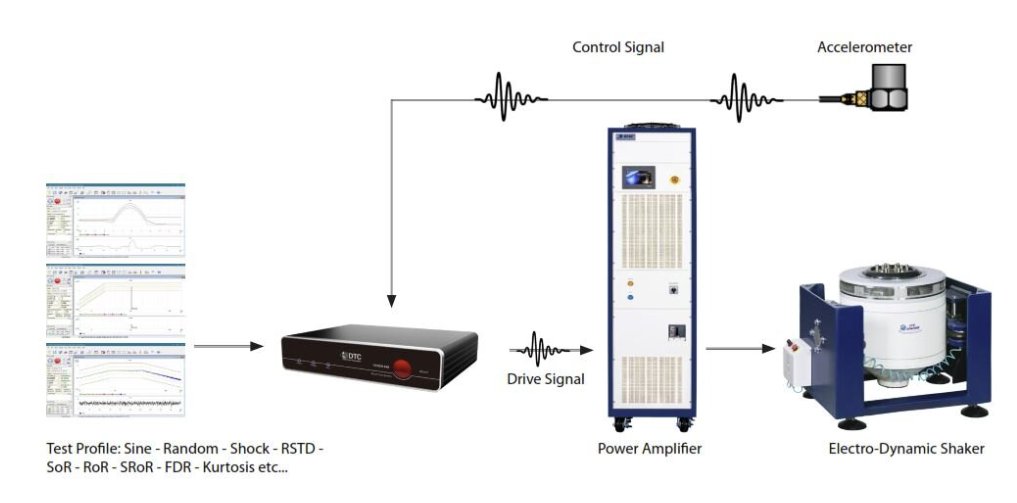
Calculating the Required Force
To calculate the necessary force for your vibration shaker, apply Newton’s Second Law of Motion:
Force (F) = Mass (M) × Acceleration (A)
This means that accelerating a mass of 1 kg at 1 m/s² requires a force of 1 Newton. But in vibration testing, mass includes more than just the item under test. You must factor in the total moving mass, such as:
• The shaker armature
• Fixtures (e.g., head expander or slip plate and driver bar)
• Test specimen
• Interface fixtures, bolts, and even friction from hydrostatic bearings (if using a slip table)
Acceleration: What You Need to Know
The acceleration value (A) depends on the test type and customer specifications:
• Sine Vibration – peak acceleration (G-peak)
• Random Vibration – root mean square (G-rms)
• Shock Testing – peak acceleration (G-peak)
Force Requirement Formula
To estimate the shaker force needed:
Total Moving Mass × Max Acceleration = Required Force x 1.3 (30 % Safety Margin)
Use this approach to ensure your shaker system is capable of handling the test reliably, without exceeding limits.
Additional Parameters to Check
Along with force, always verify:
• Maximum Displacement – based on test frequency and acceleration
• Maximum Velocity – influenced by waveform and frequency content
Considering all these factors will help you select a vibration testing system that meets performance needs without overloading the equipment.
Need Help Selecting the Right Vibration Shaker?
Choosing the correct vibration shaker system can be complex—but you don’t have to figure it out alone. At ETS Solutions, our team of experts is here to help. Whether you’re unsure about force requirements, waveform types, or fixture compatibility, we’ll guide you every step of the way. Let us help you build a customized solution tailored to your testing specifications and budget.
📩 Contact us today to find the ideal vibration testing system for your needs.