
Slip Tables & Multi-Axis Testing: Tips & Tricks
Practical guidance for reliable horizontal and multi-directional vibration testing
Vibration testing is rarely limited to a single direction. In real-world environments—whether in automotive, aerospace, or electronics—products are exposed to forces from multiple axes.
That’s why engineers rely on slip tables and multi-axis testing setups to simulate real operating conditions more accurately.
This guide focuses on what matters in practice:
how slip tables work
how to switch between vertical and horizontal testing
what challenges engineers face—and how to solve them
What a Slip Table Does (and Why It Matters)
A slip table converts vertical shaker motion into controlled horizontal vibration, allowing engineers to simulate real-world lateral forces.
When you need a slip table
Transport vibration (truck, rail, shipping)
Lateral loads in vehicles
Multi-directional stress on assemblies
Without a slip table, your test only reflects part of the real-world condition.
ETS Slip Tables: What Engineers Should Know
At ETS, slip tables are not treated as simple accessories—they are engineered as core system components that directly impact test accuracy, stability, and repeatability.
Two types of slip table are available: a unibase concept that provides a structural steel body to align the shaker and table on a rigid platform, and a standalone slip table design that allows the feasibility of any vertical shaker from ETS or other manufacturers to couple with the slip table assembly.
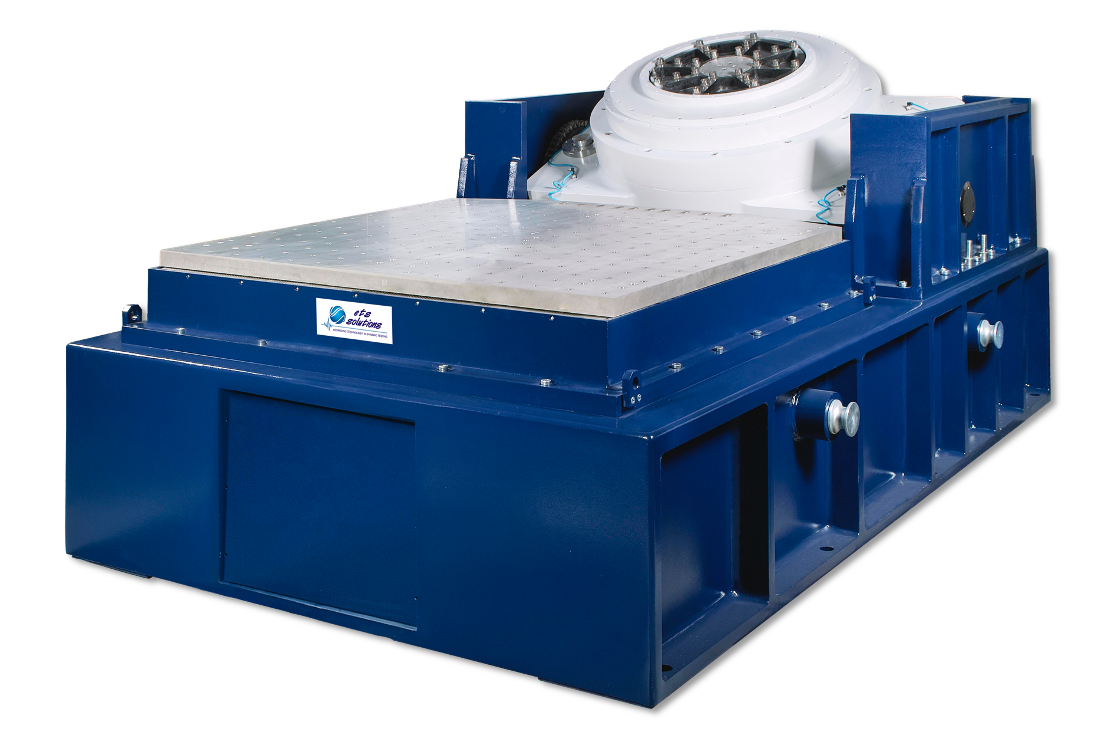
ETS Solutions Unibase Slip Table Concept
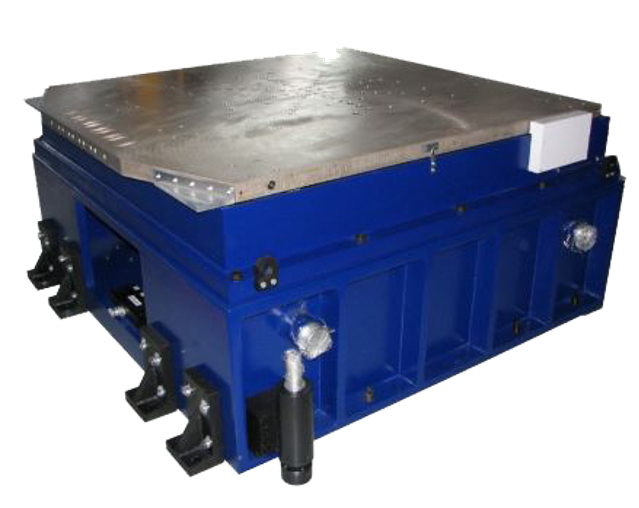
ETS Solutions Standalone Slip Table Concept
ETS Solutions provide also double slip table unibase that allows users to have double configuration of the slip table in order to perform different tests. The shaker system can rotate 180 degree in order to be combined with both tables. In the middle position, the shaker can be combined with the Head Expander in order to perform vertical test. This configuration is suitable for GT Series and BT Series.
Table in table unibase solution is also available. It allows users to have double configuration of the slip table in order to perform different tests. The small and the big tables are integrated in order to save space in the lab. In order to perform the test with the small table, the user has just to detach it from the bigger table. Simple configuration and easy to use. This configuration is suitable for GT Series and BT Series.
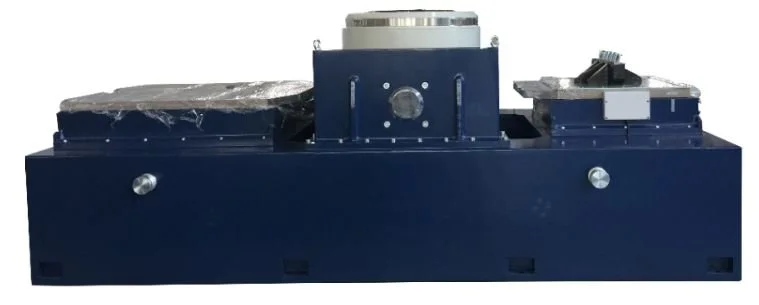
ETS Solutions double slip table unibase
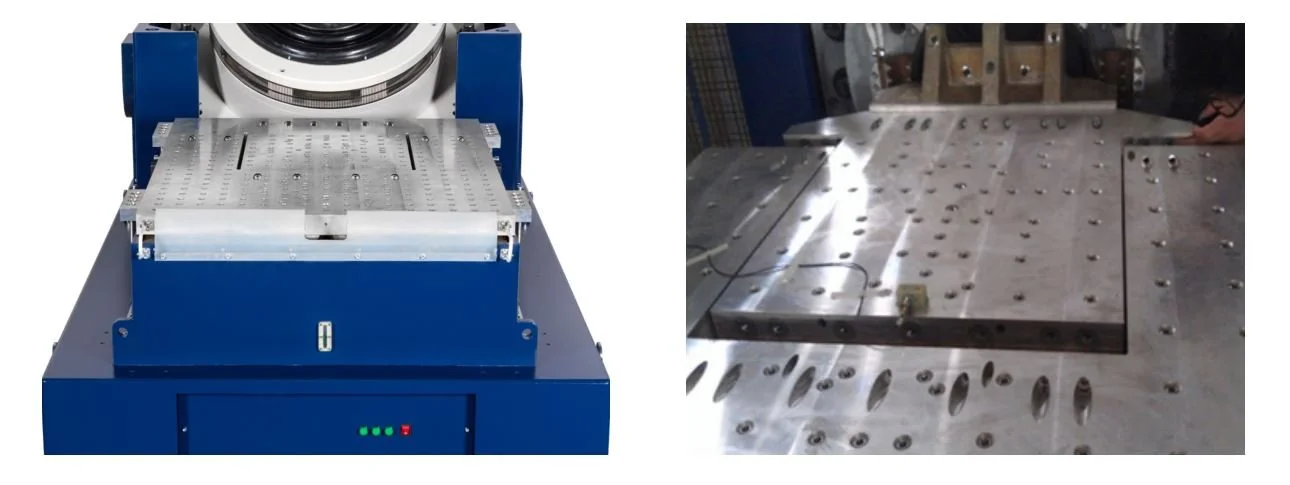
ETS Solutions Table in table unibase slip table concept
Key Engineering Features
Precision granite base
A natural granite slab provides a flat, stable reference surface, ensuring consistent motion and minimizing distortion during testing.
Oil film technology (GT Series)
A thin oil layer between the slip plate and granite base enables:
ultra-low friction motion
reduced wear
natural damping of pitch, roll, and yaw
Hydrostatic bearing systems (BT Series)
Designed for demanding applications:
high load and overturning moment capacity
superior cross-axis constraint
stable performance for large or tall DUTs
Wide size range
From 300 × 300 mm up to 2.5 × 2.5 m + special sizes and shapes, supporting:
small component testing
large automotive and aerospace assemblies
Low-profile, high-stability structure
optimized mass-to-force ratio
vibration isolation (<5 Hz transmission)
compatibility with environmental chambers
👉 Related systems and accessories:
Head expanders & fixtures: https://www.etssolution.com/head-expanders-fixtures
Options & accessories: https://www.etssolution.com/options-accessories
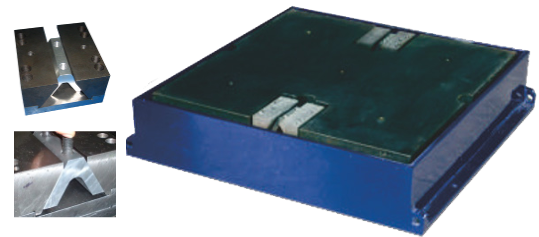
ETS Solutions Slip Table GT Series
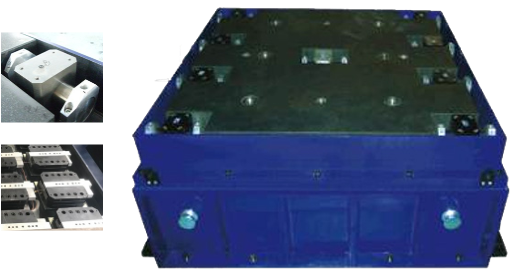
ETS Solutions Slip Table BT Series
What This Means for Engineers
These features translate directly into measurable benefits:
✔ Higher control accuracy
Stable motion reduces control error in sine and random testing
✔ Minimal cross-axis interference
Critical for standard compliance and data integrity
✔ Capability for large and complex DUTs
Hydrostatic systems support high center-of-gravity loads
✔ Faster, repeatable setups
Integrated system design maintains alignment between shaker and table
Choosing the Right ETS Slip Table
GT Series (Oil Film + Bearings)
→ Ideal for general-purpose horizontal testing
→ Reliable and cost-effectiveBT Series (Hydrostatic Bearings)
→ Ideal for heavy DUTs or high moment loads
→ Maximum stability and precision
👉 Key insight:
In multi-axis testing, the slip table often defines performance more than the shaker itself.
Vertical vs Horizontal Testing: Key Differences
Vertical Testing
Direct excitation through the shaker armature
Simpler setup
Higher usable force
Best for:
component testing
resonance studies
standard qualification
Horizontal Testing (Slip Table)
Motion transferred through bearings and slip plate
More sensitive to alignment and setup
Enables realistic simulation
Best for:
transport simulation
large assemblies
real-world mounting conditions
What Is Multi-Axis Testing?
In most labs, multi-axis testing means:
sequential testing across axes (X, Y, Z)
rotating the DUT or reconfiguring setups
combining slip tables with fixtures
Advanced systems may include:
dual-axis excitation
vibration + environmental testing
Practical Challenges (and How to Solve Them)
1. Switching Between Axes
Challenge:
Time-consuming setup and reconfiguration
Solution:
use modular fixtures
standardize mounting interfaces
validate setup with low-level tests
2. Alignment and Side Loads
Challenge:
Misalignment causes distortion and instability
Solution:
ensure precise installation
center payload correctly
verify motion before testing
3. High Center of Gravity Loads
Challenge:
Instability and excessive moments
Solution:
use reinforced slip tables (e.g., hydrostatic)
lower center of gravity
add support fixtures
4. Fixture Design Across Axes
Challenge:
Different load paths in vertical vs horizontal
Solution:
design for multi-directional stiffness
avoid flexible structures
validate with sine sweep
5. Cable Management
Challenge:
Cable movement introduces noise
Solution:
secure cables close to sensors
avoid loops
re-check after axis changes
6. Control Stability
Challenge:
Horizontal systems behave differently
Solution:
run pre-tests (low-level sine/random)
verify FRF
adjust control parameters
Tips for Efficient Multi-Axis Testing
Complete tests in one axis before switching
Keep sensor positions consistent
Document every setup detail
Standardize fixtures for repeatability
When to Upgrade Your Setup
If you experience:
unstable horizontal tests
long setup times
inconsistent results
…it may be time to review your system configuration.
👉 Explore ETS solutions:
https://www.etssolution.com/options-accessories
FAQ
Do I always need a slip table for horizontal testing?
Yes, for accurate and repeatable horizontal vibration.
Why is horizontal testing more difficult?
Because of additional components, alignment sensitivity, and fixture requirements.
What’s the biggest mistake in multi-axis testing?
Ignoring fixture design and alignment when switching axes.
Can one fixture work for all axes?
Only if designed for multi-directional stiffness.
Final Thoughts
Slip tables and multi-axis testing bring your testing closer to reality but they also require more engineering discipline.
Most issues don’t come from the shaker itself.
They come from:
alignment
fixtures
setup consistency
👉 And in horizontal testing, the slip table often determines your final result quality.
That’s why ETS approaches vibration testing as a complete system - not just a shaker, but a fully engineered solution.