
Air-Cooled vs Water-Cooled Electrodynamic Shakers
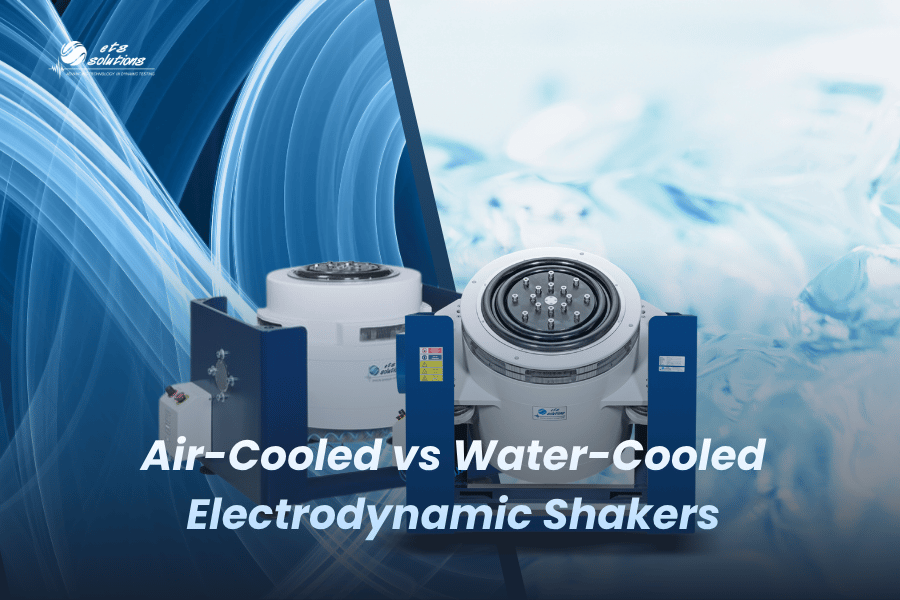
Short answer: should you choose an air-cooled or water-cooled shaker?
Choose an air-cooled electrodynamic shaker when your lab needs a practical, lower-complexity system for small to medium payloads, general product qualification, electronics, automotive components, and standard reliability testing.
Choose a water-cooled electrodynamic shaker when your application requires higher force, heavier payloads, long-duration high-power testing, demanding aerospace or defense programs, large assemblies, or more advanced system configurations.
The right choice depends on the full test requirement: payload, fixture mass, frequency range, displacement, acceleration, duty cycle, facility conditions, and future testing needs.
Why this decision matters
When engineers compare vibration test systems, force rating usually gets most of the attention.
But cooling type is just as important.
The cooling method affects:
system performance
installation requirements
facility preparation
acoustic noise
operating cost
maintenance planning
long-duration testing capability
future test flexibility
A shaker may look suitable on paper, but if the cooling system does not match the application or facility, the lab may face installation delays, performance limits, higher running costs, or operational problems later.
That is why the choice between air-cooled and water-cooled systems should be made early in the buying process.
What is an electrodynamic shaker?
An electrodynamic shaker is a vibration testing system that uses electromagnetic force to generate controlled vibration.
It is commonly used for:
product qualification
durability testing
reliability testing
transportation vibration simulation
electronics testing
automotive component testing
aerospace and defense applications
EV battery component testing
industrial product validation
packaging and shipping tests
A complete vibration test system may include:
electrodynamic shaker
power amplifier
vibration controller
slip table
head expander
fixture
sensors
accessories
environmental chamber interface
service and support package
The shaker creates the motion.
The complete system determines how useful, repeatable, and reliable the test results are.
What is an air-cooled electrodynamic shaker?
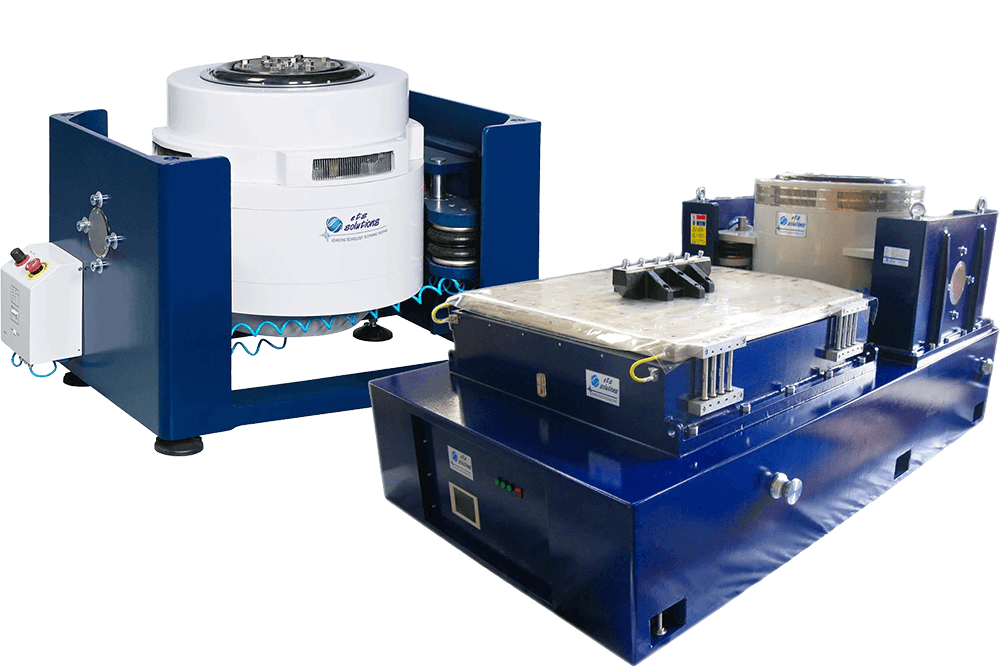
An air-cooled electrodynamic shaker removes heat from the shaker body using forced air, usually through a blower and ducting system.
Air-cooled systems are widely used because they are simpler to install and operate compared with water-cooled systems.
They are often a good fit for labs that need:
compact systems
moderate force levels
simpler facility requirements
lower installation complexity
general product reliability testing
small to medium payload testing
electronics or automotive component validation
Air-cooled systems are commonly used in engineering labs, production test areas, quality departments, and R&D environments where flexibility and ease of use matter.
What is a water-cooled electrodynamic shaker?
A water-cooled electrodynamic shaker removes heat using water circulation, often with facility water or a dedicated cooling system.
Water cooling is typically used for larger or higher-force shaker systems because it removes heat more efficiently during demanding tests.
Water-cooled systems are often used when the lab needs:
higher force capacity
heavier payload testing
longer high-level test durations
demanding aerospace or defense applications
larger industrial assemblies
complex qualification programs
reduced dependence on large air exhaust systems
stable operation during high-power testing
Water-cooled systems usually require more facility planning than air-cooled systems. The lab must consider water supply, flow rate, temperature control, maintenance access, and installation layout.
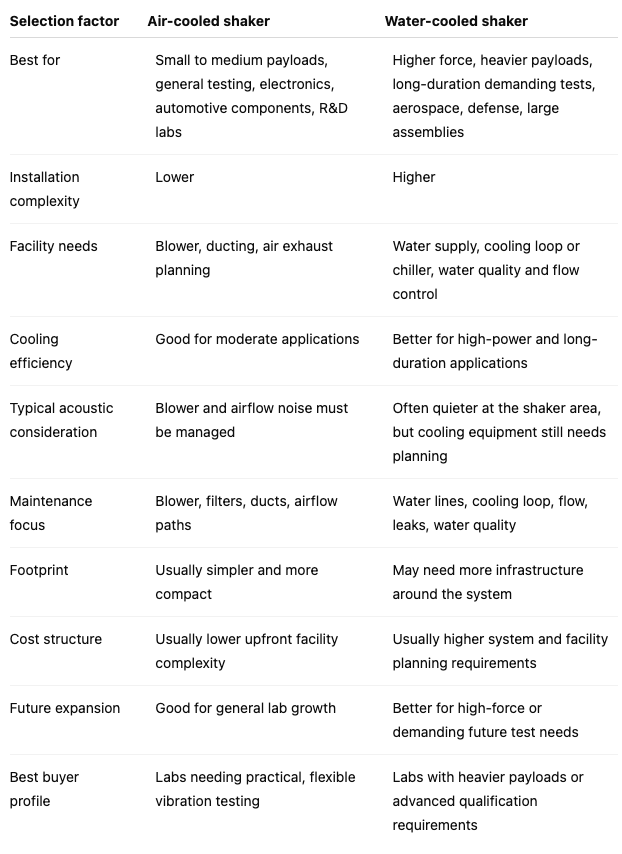
Air-cooled vs water-cooled shakers: quick comparison
The main benefits of air-cooled electrodynamic shakers
1. Simpler installation
Air-cooled systems are often easier to install because they do not require facility cooling water.
The main requirements are usually:
enough space for the shaker
blower placement
ducting or exhaust routing
power supply
floor preparation
controller and amplifier setup
access for operation and maintenance
This makes air-cooled systems attractive for labs that want to add vibration testing capability without major facility changes.
2. Practical for small and medium payloads
Many labs do not need the largest shaker available.
They need a system that can reliably test:
electronic assemblies
automotive components
sensors
connectors
small mechanical parts
packaging samples
household appliance components
industrial devices
sub-assemblies
For these applications, an air-cooled shaker can provide the right balance of performance, cost, footprint, and usability.
3. Lower facility complexity
Water-cooled systems need water supply planning. Air-cooled systems avoid that.
This can be important when:
the lab has limited infrastructure
water access is difficult
the system needs to be installed quickly
the test area may change in the future
the customer wants simpler maintenance
the facility team wants fewer utilities to manage
For many test labs, simpler infrastructure is a real advantage.
4. Good fit for flexible test environments
Air-cooled systems are often suitable for labs that test many different products rather than one very large product.
They can support a wide range of reliability and qualification tests when selected correctly.
Typical applications include:
electronics reliability testing
automotive component testing
small industrial product testing
packaging vibration testing
production screening
R&D validation
education and research labs
The main benefits of water-cooled electrodynamic shakers
1. Higher force and performance potential
Water-cooled systems are usually selected when the application requires higher force or more demanding test conditions.
This may include:
heavier payloads
larger fixtures
long-duration testing
high-level random vibration
demanding qualification profiles
aerospace or defense test programs
large automotive or industrial assemblies
When heat generation becomes a limiting factor, water cooling can support higher sustained performance.
2. Better heat removal for demanding tests
Vibration testing generates heat inside the shaker system.
The harder and longer the system works, the more important cooling becomes.
Water cooling can remove heat efficiently during high-power test profiles. This helps the system operate more consistently during demanding tests, provided the facility cooling setup is designed correctly.
3. Suitable for complex applications
Water-cooled shakers are often used for applications where performance margins matter.
Examples include:
satellite component testing
avionics testing
military electronics
aerospace assemblies
large payload testing
high-force durability programs
combined environmental setups
high-value qualification programs
These applications often require careful system sizing, strong fixture design, reliable amplification, and service support.
4. Potential acoustic advantage at the test area
Air-cooled systems use blowers and airflow, which can create noise around the lab.
Water-cooled systems may reduce some of the intake and exhaust noise associated with air cooling. However, the total acoustic environment still depends on the full installation, including pumps, cooling equipment, facility layout, and room treatment.
For labs where operator comfort or acoustic conditions matter, this should be reviewed during system planning.
When should you choose an air-cooled shaker?
Choose an air-cooled electrodynamic shaker when your test requirements are moderate and the lab needs a practical, flexible system.
Air-cooled systems are often suitable when:
payloads are small to medium
force requirements are moderate
testing is mainly electronics, components, or sub-assemblies
installation simplicity matters
facility cooling water is not available
the lab needs lower infrastructure complexity
test profiles are not continuously high-power
the system will support multiple general applications
Typical air-cooled applications
Air-cooled systems are commonly used for:
automotive sensors and connectors
ECUs and electronic modules
small battery components
consumer electronics
industrial control units
packaging tests
home appliance components
research and teaching labs
For many labs, an air-cooled shaker is the most practical starting point for in-house vibration testing.
When should you choose a water-cooled shaker?
Choose a water-cooled electrodynamic shaker when the application requires higher performance, heavier payload capacity, or more demanding long-duration operation.
Water-cooled systems are often suitable when:
payloads are heavier
force requirements are high
test profiles are demanding
long-duration high-level testing is expected
the application is aerospace, defense, space, or high-value industrial testing
larger slip tables or fixtures are needed
the system must support complex qualification programs
the facility can support water cooling infrastructure
Typical water-cooled applications
Water-cooled systems are commonly used for:
aerospace components
avionics systems
defense electronics
satellite-related hardware
heavy automotive assemblies
EV battery-related testing
industrial machinery components
large test fixtures
combined environmental + vibration setups
Water-cooled systems usually require more planning, but they can provide the performance needed for applications where air-cooled systems may be limited.
Key questions before choosing air-cooled or water-cooled
Before selecting a system, define the real test requirement.
Ask these questions:
What is the device under test?
What is the DUT mass?
What is the fixture mass?
What is the total moving mass?
What force level is required?
What frequency range is required?
What displacement is required?
What velocity and acceleration are required?
Will the test be vertical, horizontal, or both?
Is a slip table needed?
Is a head expander needed?
Will testing run for long durations?
Is the profile low-level, high-level, or continuous?
Is environmental chamber integration required?
What standards or customer specifications apply?
What utilities are available in the lab?
What future test requirements may appear later?
A good choice is not just the system that works today.
It is the system that still supports the lab’s testing needs in three, five, or ten years.
Standards and application requirements
Cooling type is not usually selected because a standard says “air-cooled” or “water-cooled.”
It is selected because the test profile, payload, and duty cycle require a certain level of system performance.
Standards and customer specifications may define:
vibration profile
frequency range
acceleration
displacement
test duration
number of axes
mounting direction
environmental conditions
acceptance criteria
Common standards that may be relevant, depending on the industry and product, include:
MIL-STD-810 for environmental testing of military and rugged equipment
DO-160 for environmental conditions and test procedures for airborne equipment
ISO 16750 for road vehicle electrical and electronic equipment
ISTA for packaging and transport simulation
ASTM and IEC standards depending on the application
The shaker system should be selected after reviewing the actual test profile, not just the industry name.
For related guidance, see:
Why Certification Standards Matter in Vibration Testing
Facility requirements: what labs often underestimate
1. Space and access
The shaker itself is only one part of the installation.
The lab also needs space for:
power amplifier
blower or cooling equipment
controller
slip table
fixture storage
environmental chamber, if used
service access
cable routing
operator area
safety clearance
A system that fits physically may still be difficult to operate if service access is not planned.
2. Power supply
Both air-cooled and water-cooled systems need suitable electrical infrastructure.
The power requirement depends on the shaker size, amplifier, blower or cooling system, and accessories.
Before purchase, the lab should confirm:
available voltage
phase requirements
power capacity
grounding
cable routing
local electrical safety requirements
3. Cooling and exhaust
Air-cooled systems require airflow planning.
The lab should consider:
blower location
duct length
exhaust route
heat released into the room
acoustic noise
filter access
maintenance space
Water-cooled systems require water planning.
The lab should consider:
water flow
temperature control
water quality
chiller or facility water
leak prevention
hose routing
cooling system maintenance
Cooling should not be treated as an afterthought. It is part of system performance.
4. Floor and foundation
The lab floor must support the system and control vibration transmission.
This is especially important for:
large shakers
slip table systems
heavy fixtures
high-force tests
sensitive nearby equipment
combined chamber setups
Depending on the system and application, floor loading, isolation, and foundation planning may need review before installation.
5. Noise and operator environment
Air-cooled systems can involve blower noise. Water-cooled systems may reduce some airflow noise near the shaker, but pumps and cooling equipment may still create noise elsewhere.
Labs should consider:
operator comfort
sound level limits
test area layout
nearby offices or labs
acoustic treatment if required
Air-cooled vs water-cooled: common mistakes
Mistake 1: Choosing only by price
Air-cooled systems may have lower installation complexity, but that does not automatically make them the best choice.
Water-cooled systems may require more infrastructure, but they may be necessary for demanding profiles.
The correct choice depends on the test requirement.
Mistake 2: Ignoring future test needs
A lab may only need to test small components today.
But future programs may require:
heavier payloads
larger fixtures
horizontal testing
combined environmental testing
higher force
longer duration
different standards
If growth is likely, the system should be selected with some margin.
Mistake 3: Underestimating fixture mass
Fixture mass is part of the moving mass.
A test that looks possible with the DUT alone may become unrealistic once the fixture, head expander, fasteners, cables, and sensors are included.
Always calculate the total moving mass.
For related guidance, see:
How to Calculate the Required Force for a Vibration Shaker
Mistake 4: Treating cooling as a facility detail only
Cooling affects the shaker’s ability to perform.
A poor cooling setup can reduce system performance, increase maintenance risk, or make the lab harder to operate.
Cooling should be discussed during system selection, not after the purchase decision.
Mistake 5: Not reviewing horizontal testing needs
Some labs buy a vertical-only setup and later discover they need horizontal testing.
If the lab will test automotive parts, battery components, transportation packaging, or larger assemblies, slip table requirements should be reviewed early.
For related guidance, see:
Slip Tables & Multi-Axis Testing: Tips & Tricks
Real application examples
Electronics and small component testing
A lab testing small electronic assemblies, sensors, connectors, or control units may choose an air-cooled shaker because it offers practical performance with simpler installation.
Typical needs:
moderate payload
repeatable sine or random tests
compact system footprint
quick setup
flexible fixture options
manageable facility requirements
Automotive component testing
Automotive labs may use either air-cooled or water-cooled systems depending on the part.
Air-cooled systems may fit smaller components such as:
sensors
connectors
ECUs
brackets
interior parts
small assemblies
Water-cooled systems may be considered for:
heavier assemblies
larger fixtures
EV battery-related components
long-duration durability testing
demanding customer profiles
For related guidance, see:
What Equipment Is Used for Automotive Vibration Testing?
Aerospace and defense testing
Aerospace and defense programs often involve strict test profiles, documentation, high-value components, and demanding reliability requirements.
Water-cooled systems may be more suitable when the lab needs higher force, larger payloads, or long-duration performance.
Typical applications include:
avionics
satellite components
defense electronics
aircraft-mounted assemblies
communication equipment
ruggedized systems
For related guidance, see:
Aerospace Vibration Testing Standards: Ensuring Compliance with MIL-STD-810 and DO-160
Combined environmental + vibration testing
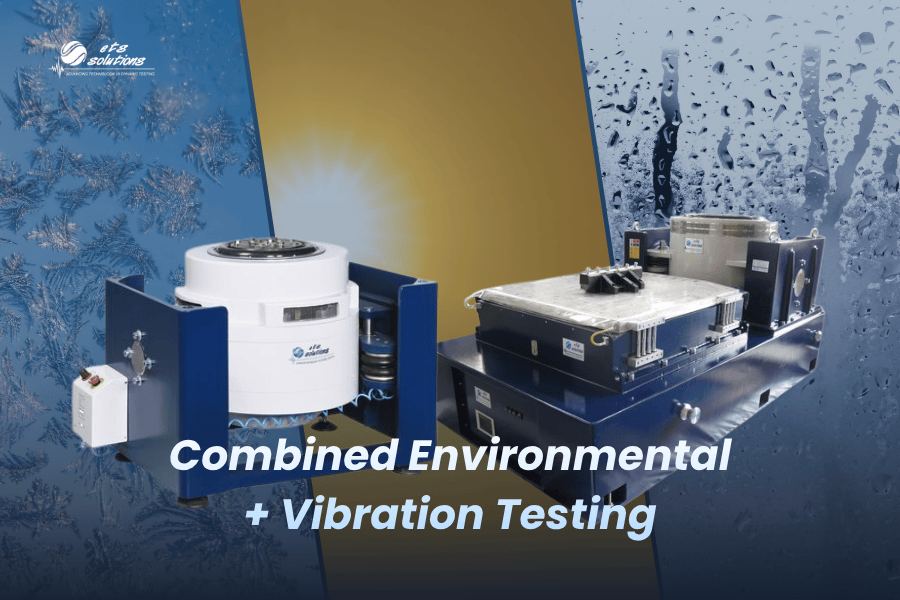
When vibration must be combined with temperature, humidity, or altitude-related conditions, system selection becomes more complex.
The lab must review:
shaker size
chamber interface
thermal barrier
fixture material
cable routing
sensor suitability
airflow
condensation risk
cooling system
service access
Both air-cooled and water-cooled systems may be used depending on the test requirement, but more demanding combined setups often need stronger planning and higher performance margins.
For related guidance, see:
Combined Environmental + Vibration Testing
How ETS helps labs choose the right shaker system
ETS Solutions provides vibration testing equipment and complete system components for product qualification and reliability testing.
Depending on the application, ETS can support system configurations that include:
electrodynamic shakers and exciters
power amplifiers
vibration control software and hardware
slip tables
head expanders
fixtures
options and accessories
environmental chamber integration
service support
ETS helps customers review the full test requirement, including payload, frequency range, displacement, velocity, acceleration, fixture needs, test direction, standards, and facility conditions.
The goal is not just to supply a shaker.
The goal is to help the lab configure a system that fits the real application.
Explore:
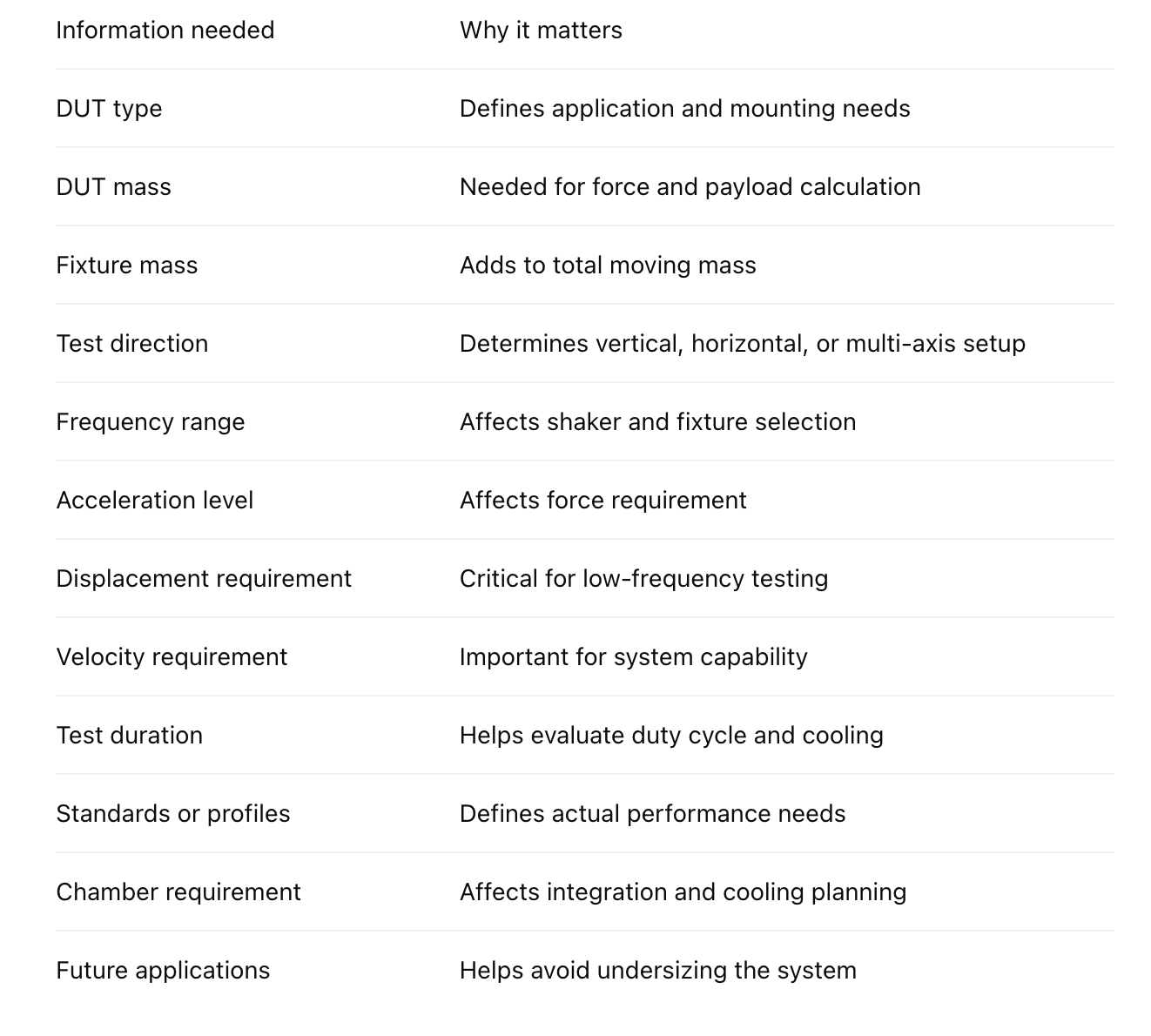
Buyer checklist: what to send before requesting a recommendation
To help ETS recommend the right configuration, prepare the following information:
FAQ
-
Air-cooled shakers use forced air to remove heat, while water-cooled shakers use water circulation. Air-cooled systems are usually simpler to install. Water-cooled systems are often selected for higher force, heavier payloads, and more demanding test profiles.
-
Yes. Air-cooled shakers are widely used for reliability testing of small to medium payloads, electronics, automotive components, packaging, and general product qualification.
-
Choose a water-cooled shaker when the test requires higher force, heavier payloads, long-duration high-level operation, larger fixtures, or demanding aerospace, defense, industrial, or combined environmental applications.
-
No. A water-cooled shaker is not automatically better. It depends on the test requirement. For many labs, an air-cooled shaker is more practical and easier to install. For high-force or demanding tests, water cooling may be necessary.
-
Yes. Air-cooled shaker systems typically use a blower and airflow path to remove heat from the shaker.
-
Some systems may use facility cooling water, while others may require a dedicated chiller or cooling loop. The exact requirement depends on the system and facility.
-
It depends on the component. Smaller automotive electronics, sensors, connectors, and sub-assemblies may be suitable for air-cooled systems. Larger assemblies, heavier payloads, or demanding durability profiles may require water-cooled systems.
-
Aerospace testing often requires higher performance, strict control, and larger safety margins. Water-cooled systems may be appropriate for demanding aerospace applications, but the final choice depends on the test profile, payload, frequency range, and standards.
-
Yes, depending on the system configuration. Slip table compatibility should be reviewed during system selection, especially for horizontal testing, automotive applications, battery testing, and larger assemblies.
-
Start with the test requirement: payload, fixture mass, frequency range, acceleration, displacement, velocity, test direction, standards, duty cycle, and facility conditions. ETS can review these details and recommend a suitable system configuration.
Final takeaway
The choice between air-cooled and water-cooled electrodynamic shakers is not only a technical detail.
It affects the whole lab setup.
Air-cooled shakers are often the practical choice for small to medium payloads, general reliability testing, electronics, automotive components, and labs that need lower installation complexity.
Water-cooled shakers are often the better choice for high-force, heavy-payload, long-duration, aerospace, defense, industrial, and complex qualification applications.
The best system is the one that matches your actual test profile, facility, and future requirements.
Need help choosing between an air-cooled and water-cooled shaker system? Contact ETS with your payload, test profile, frequency range, displacement needs, and application. ETS can help recommend the right configuration for your lab.