
Combined Environmental + Vibration Testing
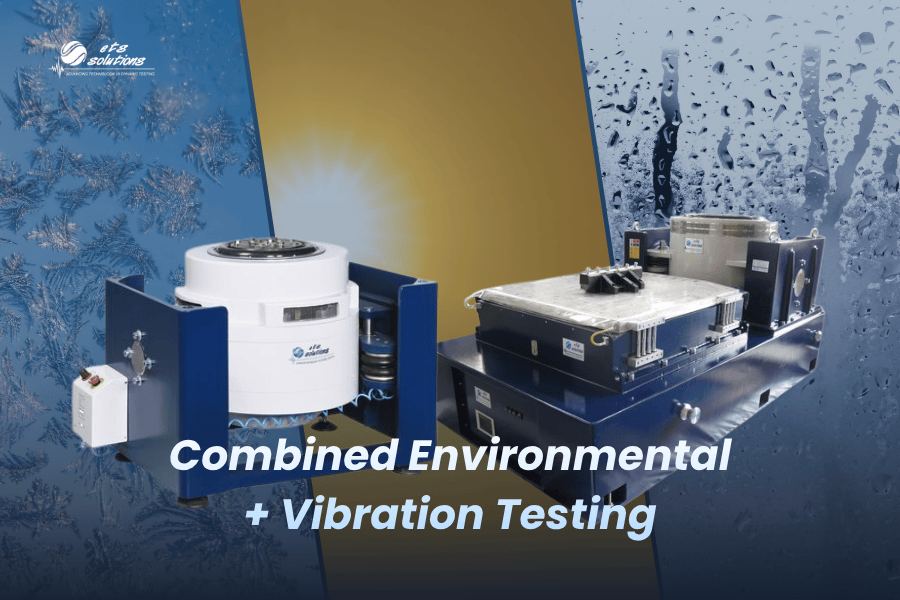
Combined Environmental + Vibration Testing: Challenges & Solutions
How to run temperature, humidity, altitude, and vibration in one setup—and get results you can trust.
Products rarely fail because of just one stress.
A battery pack may see vibration on rough roads, heat during charging, cold overnight, moisture in coastal climates, and lower pressure during air transport. An avionics unit may face altitude, rapid temperature change, and vibration in the same qualification program. That is why combined testing matters: it brings multiple real-world stresses together instead of testing each one in isolation. ETS covers this kind of integration, including shaker systems that work with climatic chambers, custom fixtures, slip tables, and thermal barriers for combined tests.
Across the vibration and environmental test market, major manufacturers are doing the same. That tells you something important: combined environmental + vibration testing is no longer a niche setup. It is becoming a standard expectation in aerospace, automotive, electronics, batteries, and defense.
This guide explains what combined testing is, when to use it, what usually goes wrong, and how to solve it.
What combined environmental + vibration testing actually means
In practical terms, combined testing puts a product through mechanical vibration while also controlling one or more environmental conditions in a chamber, such as:
temperature
humidity
altitude or reduced pressure
thermal cycling
sometimes temperature change rate requirements
The goal is simple: simulate the real service environment more closely than a single-stress test can.
For ETS, this is a natural fit with the current product structure. We have:
shaker systems that can be combined into full environmental test systems,
slip tables for horizontal testing, including unibase and standalone concepts,
head expanders and fixtures for larger or more complex DUTs,
climatic chambers and related accessories.

When should you use combined testing instead of separate tests?
A lot of teams ask the same question:
“Can we just run vibration first and temperature later?”
Sometimes yes. But not always.
Separate tests are useful for basic screening and early design work. Combined tests become more important when:
materials behave differently under heat, cold, or moisture while vibrating,
seals, connectors, solder joints, adhesives, or housings are sensitive to thermal expansion and contraction,
the product is expected to perform in transport and operation under changing environmental conditions,
standards or customer requirements call for combined stress conditions. Combined systems are often needed for standards such as DO-160 and ISO 16750.
In other words, if failure depends on interaction between stresses, you need combined testing.
Typical examples
Automotive electronics and battery systems: road vibration plus heat, cold, and humidity.
Aerospace and defense hardware: vibration plus temperature extremes and, in some programs, altitude.
Consumer and industrial electronics: thermal cycling plus vibration can expose solder fatigue, connector fretting, and enclosure weaknesses.
See also Why Certification Standards Matter in Vibration Testing
The biggest technical challenges in combined testing
This is where things get real.
Combined testing is not just “put the shaker under a chamber.” The setup is more sensitive than a normal vibration test, and small integration mistakes can affect data quality, chamber performance, or even hardware life.
1) Thermal barrier and interface design
The interface between shaker and chamber is one of the first problem areas.
Why it matters:
the shaker should not be exposed directly to chamber extremes beyond what the system is designed to handle,
the chamber opening needs to limit heat leak,
the interface has to allow motion without creating friction, misalignment, or unintended stiffness.
If this area is not designed properly, you can get:
condensation,
ice or moisture buildup,
heat leakage,
mechanical interference,
inaccurate test response.
What works
use a proper thermal barrier sized for the shaker and chamber opening,
verify the moving interface across the full displacement range,
review chamber airflow and thermal uniformity with the barrier in place,
confirm that the DUT, fixture, and cable routing do not bridge thermal zones in a way that changes results.
Explore integration options:
2) Fixture design under temperature, humidity, and vibration
A fixture that works well at room temperature may not behave the same way inside a hot, cold, or humid chamber.
That is especially true for:
mixed-material fixtures,
adhesives or bonded mounting,
tall structures with high thermal expansion mismatch,
fixtures with low stiffness margins.
Fixturing is not an afterthought. ETS is offering lightweight head expanders and fixtures in magnesium or aluminum alloy, and custom fixture solutions for different applications.
What engineers need to watch
thermal expansion can change clamp loads,
condensation can affect insulation, fasteners, and cable routing,
reduced stiffness at temperature can move a fixture resonance into the test band,
chamber-compatible materials matter.
What works
validate fixture resonance with a low-level sweep before full combined testing,
design for stiffness across the actual chamber temperature range,
reduce unnecessary mass,
use chamber-suitable materials and finishes.
See:
Common Vibration Test Issues and How to Solve Them
3) Chamber airflow versus vibration setup geometry
This is one of the most overlooked issues.
A chamber may be capable of hitting the required temperature or humidity in an empty condition, but once you install:
the DUT,
a fixture,
cables,
thermal barrier,
and the shaker interface,
the airflow pattern changes.
That affects:
temperature uniformity,
humidity distribution,
condensation risk,
stabilization time.
What works
evaluate the airflow path around the DUT, not just the chamber rating,
avoid large flat fixtures that block circulation unnecessarily,
position temperature and humidity sensors where the DUT actually sits,
allow adequate soak time before vibration begins.
4) Cable movement, feedthroughs, and instrumentation reliability
In normal vibration testing, cable management already matters. In combined testing, it matters even more.
Now the cables may be exposed to:
low temperatures,
higher temperatures,
humidity,
movement through chamber penetrations,
and vibration at the same time.
The result can be:
noisy measurements,
brittle cable behavior at low temperature,
moisture-related issues,
signal drift,
sealing problems at feedthroughs.
What works
use chamber-rated cables and sensors,
secure cables close to the sensor and fixture,
avoid long unsupported runs,
check chamber feedthrough sealing,
verify signal quality at environmental extremes, not only at room temperature.
Related:
Common Vibration Test Issues & How to Solve Them
5) Slip table integration for horizontal combined testing
Horizontal combined testing is usually more difficult than vertical combined testing.
Why:
there are more interfaces,
alignment becomes more critical,
slip table behavior has to stay stable while the chamber is integrated,
tall DUTs often bring more moment load and more airflow disruption.
ETS slip tables are designed for horizontal testing with either a unibase concept that keeps shaker and table aligned on one rigid platform, or a standalone slip table that can be coupled with ETS or other vertical shakers.
That matters because in a combined chamber setup, alignment and platform rigidity are not just convenience features. They directly affect:
control stability,
cross-axis behavior,
repeatability after chamber installation,
and service access.
What works
use the right slip table architecture for the payload and chamber arrangement,
review center of gravity and overturning moment early,
keep access for installation and maintenance in mind,
validate horizontal performance after chamber integration, not before.
Learn more:
6) Altitude changes the test conversation
Temperature and humidity are already challenging. Add altitude, and the setup becomes even more sensitive.
Altitude or reduced-pressure testing can affect:
heat transfer,
outgassing behavior,
sealing performance,
arcing risk in some electronics,
and the way materials respond during vibration.
That does not mean every lab should combine altitude and vibration in the same setup by default. It does mean engineers should ask:
“Is reduced pressure part of the real environment, or can it be tested separately?”
In many programs, altitude is best used when:
the product will operate or travel at reduced pressure,
thermal behavior changes significantly with pressure,
connectors, enclosures, or vented components are pressure-sensitive.
What works
define whether the requirement is operational altitude, transport altitude, or both,
confirm chamber capability and safety before integrating vibration,
review fixture, sensor, and cable suitability under reduced pressure.
7) Control stability and repeatability
This is where labs often lose time.
A setup may look fine mechanically, but once the chamber is active:
temperatures change stiffness,
humidity affects some materials and seals,
airflow changes,
cables behave differently,
and the FRF may shift.
That can make vibration control harder to hold, especially in random testing or near resonances.
ETS positions its amplifier and system architecture around ease of operation, compatibility, and full-system integration. The MPA amplifier family is a wide-frequency-band Class D power amplifier with built-in features and compatibility with any make of electrodynamic shaker, while ETS service support offers global maintenance and training.
What works
run a low-level verification at the target environmental condition,
do not rely only on room-temperature setup checks,
re-check fixturing after thermal soak,
document the exact sequence used for stabilization and vibration start.
See:
ETS Approach: Complete System Integration
Many suppliers focus on individual components.
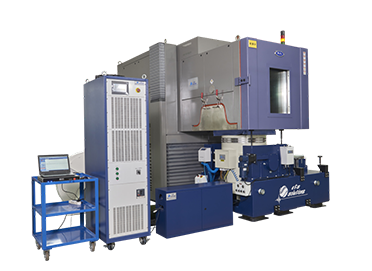
ETS focuses on the complete system:
shaker
slip table
fixtures
chamber integration
control and amplification
ETS does not just supply a shaker. ETS helps build a complete combined-test system that works in real lab conditions.
See how ETS customizes systems:
Customized Vibration Testing Solutions
How to choose the right combined setup
If you are planning a combined environmental + vibration test, start with these questions:
1) What stresses must happen at the same time?
Not every requirement needs simultaneous testing.
Ask:
Do the failure modes depend on combined stress?
Is the goal screening, qualification, correlation, or troubleshooting?
2) Vertical or horizontal?
Vertical may be simpler. Horizontal may be more realistic.
Ask:
What is the real installation orientation?
Does the DUT have a high center of gravity?
Is a slip table required?
3) What environmental conditions matter most?
Ask:
temperature only?
temperature + humidity?
altitude?
thermal cycling rate?
4) What will the fixture do at those conditions?
Ask:
Will stiffness change?
Will materials expand differently?
Are cables and sensors rated properly?
5) Can the chamber still control properly with the full setup inside?
Ask:
Is airflow blocked?
Are sensors placed where the DUT actually sees the environment?
Has stabilization time been validated?
See also Finding the Right Shaker for Your Test Application
FAQ: answers people actually search for
Can vibration and temperature be tested at the same time?
Yes. Integrated chamber-plus-shaker systems are widely used for simultaneous vibration and temperature testing, and many also support humidity.
Can you combine humidity with vibration testing?
Yes, but humidity adds complexity. Chamber airflow, cable routing, sealing, and condensation control become more important.
Can altitude be combined with vibration?
It can, depending on the program and chamber design. Altitude adds pressure-related effects and may change heat transfer and product behavior, so it should be planned carefully.
What is the biggest challenge in combined environmental and vibration testing?
Usually not the shaker alone. The biggest issues are often the integration points: thermal barriers, fixture behavior, airflow, instrumentation, and control stability.
Is horizontal combined testing harder than vertical?
Usually yes. Slip table alignment, platform stability, and center-of-gravity effects make horizontal combined testing more sensitive to setup quality. ETS’s slip table architecture is relevant here because the system design affects repeatability and ease of integration.
Final thoughts
Combined environmental + vibration testing is one of the most useful tools in modern reliability engineering because real life does not happen one stress at a time.
But it is also one of the easiest places to get misleading data if the system is not integrated properly.
The real work is not just choosing a shaker or a chamber.
It is getting the whole setup right:
chamber,
shaker,
thermal barrier,
fixture,
slip table if needed,
instrumentation,
and control.
And that’s where a complete system approach makes the difference.